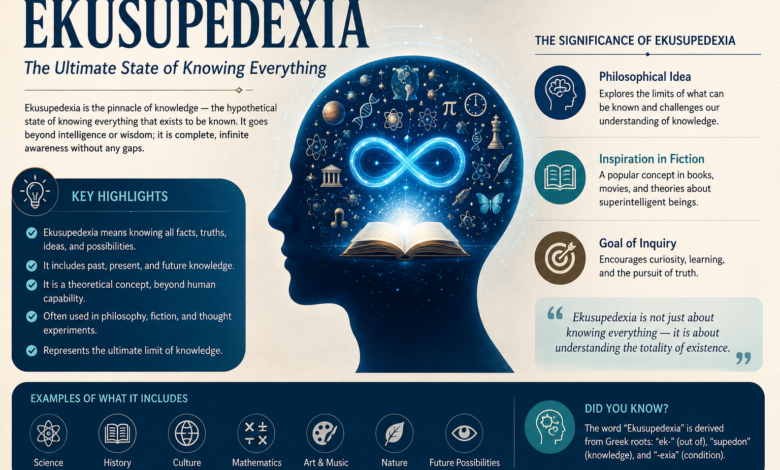
In a digital world driven by innovation, emerging concepts often gain attention before they are fully understood. Ekusupedexia is one such term that has sparked curiosity among researchers, content creators, strategists, and trend-watchers who want to understand its significance and potential applications.
Whether viewed as a conceptual framework, a developing methodology, or an evolving idea within modern knowledge systems, ekusupedexia represents a fascinating subject worth exploring. This guide examines its meaning, value, practical implications, future relevance, and the broader context surrounding its growing popularity.
Understanding the Core Meaning of Ekusupedexia
Ekusupedexia can be understood as a multidimensional concept that combines structured thinking with adaptive problem-solving. Rather than being limited to a single field, it is often discussed as a flexible approach that encourages continuous learning, innovation, and contextual decision-making. The growing interest around ekusupedexia reflects a wider shift toward knowledge management and strategic thinking in modern environments.
The concept becomes especially relevant when individuals or organizations face uncertainty and complexity. Instead of relying solely on fixed systems, ekusupedexia emphasizes adaptability, interpretation, and informed action. This connection with continuous improvement and critical analysis makes it valuable across various professional and creative disciplines.
The Origins and Evolution of Ekusupedexia
Like many emerging concepts, ekusupedexia has evolved through discussions, experimentation, and interpretation. Its development reflects the broader trend of creating frameworks that help people navigate changing circumstances while maintaining clarity and direction. The idea resonates with principles of organizational learning and innovation strategy that have become increasingly important in recent years.
As industries become more interconnected, the relevance of ekusupedexia continues to expand. Professionals are constantly searching for methods that balance structure with flexibility, making the concept attractive in diverse contexts. Its growth aligns closely with adaptive leadership and problem-solving frameworks, which are now essential components of modern success.
Why Ekusupedexia Matters Today
The modern landscape is characterized by rapid technological advancement, evolving consumer expectations, and increasing information complexity. Ekusupedexia offers a way to approach these challenges without becoming overwhelmed by constant change. It encourages thoughtful adaptation while maintaining focus on meaningful objectives through decision-making processes and performance optimization.
Organizations and individuals alike benefit from approaches that promote resilience and responsiveness. In this context, ekusupedexia provides a practical mindset that supports sustainable growth rather than short-term reactions. Its relevance is strengthened by the growing importance of digital transformation and business agility across industries.
Key Principles Behind Ekusupedexia
At its foundation, ekusupedexia is built upon observation, interpretation, adaptation, and execution. These interconnected principles help create a balanced framework for addressing challenges while remaining open to new opportunities. The emphasis on strategic planning and information synthesis helps ensure that decisions are grounded in meaningful insights.
Another defining characteristic is the ability to connect seemingly unrelated ideas into cohesive solutions. This approach supports creativity while maintaining practical relevance. By integrating systems thinking and data-driven insights, ekusupedexia enables more comprehensive and effective outcomes.
Practical Applications of Ekusupedexia
One of the reasons ekusupedexia attracts attention is its versatility. It can be applied to project management, organizational development, content strategy, education, innovation programs, and personal growth initiatives. Its broad applicability stems from its focus on process improvement and knowledge sharing rather than rigid procedures.
For example, a business facing market disruption may use -inspired principles to evaluate emerging trends and identify new opportunities. Similarly, educators can apply its concepts to create adaptive learning experiences supported by creative problem-solving and collaborative learning methods.
Benefits of Adopting Ekusupedexia
One significant benefit of ekusupedexia is increased adaptability. Individuals and organizations that embrace flexible frameworks are often better equipped to handle uncertainty and capitalize on new developments. This advantage becomes particularly evident through stronger risk management and strategic alignment practices.
Another major benefit is improved innovation capacity. By encouraging exploration and thoughtful experimentation, ekusupedexia creates an environment where new ideas can emerge and evolve. The resulting gains in operational efficiency and organizational resilience often contribute to long-term success.
Common Misconceptions About Ekusupedexia
A frequent misconception is that ekusupedexia promotes constant change without direction. In reality, the concept emphasizes purposeful adaptation guided by goals, evidence, and context. It balances flexibility with discipline through structured decision-making and performance evaluation practices.
Another misunderstanding is that is only relevant to large organizations or specialized professionals. The principles can be applied at virtually any scale, from individual projects to enterprise initiatives. This accessibility is supported by its focus on personal development and practical implementation.
Ekusupedexia and Modern Business Strategy
Businesses operate in environments where competitive advantages can shift rapidly. Ekusupedexia helps organizations remain responsive without sacrificing strategic direction. By incorporating market intelligence and competitive analysis, companies can make more informed decisions and improve their ability to navigate change.
The concept also supports cross-functional collaboration. Teams that share information effectively and adapt collectively often achieve better outcomes than those operating in isolated silos. This connection with organizational effectiveness and stakeholder engagement highlights its strategic value.
Comparing Traditional Approaches and Ekusupedexia
Traditional methods often emphasize predictability, consistency, and established procedures. While these qualities remain valuable, they may not always provide sufficient flexibility in rapidly changing environments. Ekusupedexia introduces a complementary perspective built around adaptive strategies and dynamic planning.
Rather than replacing conventional systems entirely, ekusupedexia enhances them by encouraging continuous learning and refinement. The result is a more balanced model that combines stability with innovation through process optimization and strategic flexibility.
| Aspect | Traditional Approach | Ekusupedexia Approach |
|---|---|---|
| Decision Making | Fixed procedures | Context-aware adaptation |
| Innovation | Incremental improvements | Continuous exploration |
| Learning Style | Structured and linear | Adaptive and iterative |
| Risk Response | Reactive | Proactive |
| Collaboration | Department-focused | Cross-functional |
| Growth Model | Predictable expansion | Flexible evolution |
| Problem Solving | Standardized methods | Creative solutions |
Real-World Relevance of Ekusupedexia
Imagine a company launching a new product in a highly competitive market. Unexpected consumer behaviors emerge after the launch, requiring rapid adjustments. An -based approach would encourage continuous monitoring, informed adaptation, and strategic refinement using customer insights and market feedback.
A similar principle applies to individuals pursuing career growth. Rather than relying solely on a predetermined path, professionals can evaluate changing opportunities and adjust their strategies accordingly. This flexibility is enhanced through skills development and career advancement planning.
The Future Potential of Ekusupedexia
As technology continues to reshape industries, frameworks that support adaptability will become increasingly valuable. aligns with future-focused thinking by encouraging responsiveness without losing strategic coherence. Its relevance is closely connected to emerging technologies and digital innovation trends.
Experts increasingly recognize that sustainable success depends on the ability to learn, adapt, and evolve. In this environment, ekusupedexia may continue to gain recognition as a useful framework for navigating uncertainty. Its future impact is likely to be strengthened by predictive analytics and intelligent automation capabilities.
Expert Insights on Ekusupedexia
Many thought leaders emphasize the importance of balancing stability with adaptability. reflects this perspective by encouraging structured flexibility rather than uncontrolled experimentation. The emphasis on strategic execution and continuous learning helps organizations remain competitive while pursuing long-term goals.
As one insightful observation states: “The ability to adapt intelligently is often more valuable than the ability to predict perfectly.” This quote aligns closely with the philosophy behind and its focus on organizational agility and innovation management.
Building an Ekusupedexia Mindset
Developing an mindset begins with curiosity and a willingness to learn from experience. Individuals who actively seek new perspectives are often better prepared to identify opportunities and navigate challenges. This growth-oriented approach relies heavily on knowledge acquisition and critical reflection.
The next step involves applying insights in practical ways. Rather than collecting information without action, practitioners focus on experimentation, evaluation, and refinement. These habits support lasting improvement through evidence-based decisions and continuous adaptation.
Conclusion
Ekusupedexia represents more than a trending concept. It offers a practical framework for understanding complexity, responding to change, and pursuing meaningful growth in an increasingly dynamic world.
From business strategy and innovation to personal development and organizational learning, ekusupedexia provides valuable principles that support adaptability, resilience, and informed decision-making. As industries continue to evolve, the ability to balance structure with flexibility will remain essential, making a concept worth understanding and applying.
FAQ
What is ekusupedexia?
Ekusupedexia is a flexible conceptual framework focused on adaptation, learning, and informed decision-making. It is often associated with innovation, strategic thinking, and continuous improvement.
Why is ekusupedexia important?
Ekusupedexia helps individuals and organizations respond effectively to changing conditions while maintaining focus on long-term objectives and sustainable growth.
How can businesses use ekusupedexia?
Businesses can apply ekusupedexia to strategic planning, innovation management, market analysis, and organizational development to improve adaptability and competitiveness.
Is ekusupedexia relevant for individuals?
Yes. Ekusupedexia can support personal development, career planning, skill building, and effective decision-making in both professional and personal contexts.
What makes ekusupedexia different from traditional approaches?
Unlike rigid systems, ekusupedexia emphasizes adaptability and contextual awareness while still maintaining strategic direction and purposeful action.
What is the future of ekusupedexia?
As technology and market conditions continue to evolve, ekusupedexia is likely to remain relevant as a framework that supports innovation, resilience, and intelligent adaptation.
You May Also Read: Chicago Cubs vs Milwaukee Brewers Match Player Stats