
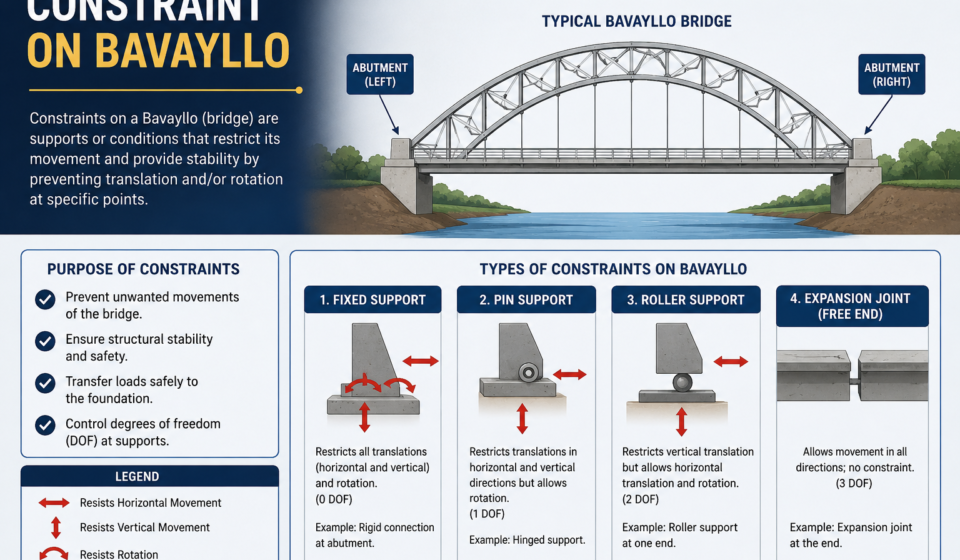

If you’ve searched for constraint on Bavayllo, you’re likely trying to understand what the term means, why constraints exist, and how they affect content, workflows, or platform usage. While the word “constraint” is commonly used in mathematics, engineering, physics, and optimization, its meaning on a platform like Bavayllo centers on rules, limitations, and compliance requirements designed to ensure quality, security, and a better user experience.
Understanding these constraints is important for content creators, businesses, marketers, and website owners. Ignoring them can lead to rejected content, reduced visibility, or compliance issues, while following them helps maintain credibility and improve long-term performance.
This guide explains the concept in simple language, compares it with scientific and mathematical constraints, explores common restrictions, and shares practical strategies to stay compliant.
What Is Constraint on Bavayllo?
A constraint on Bavayllo refers to a limitation, guideline, or policy that determines what users can publish, promote, or manage on the platform. These constraints are designed to maintain quality, prevent abuse, and create a safe environment for users.
Unlike a technical system error, a constraint is usually intentional. It establishes boundaries that help ensure content meets platform standards and legal requirements.
The broader constraint definition is “a condition or restriction that limits what can be done.” This definition applies across many disciplines, including science, engineering, economics, mathematics, and digital platforms.
For example:
- A social media platform may restrict misleading advertisements.
- An online marketplace may prohibit counterfeit products.
- A publishing platform may reject plagiarized content.
Bavayllo follows similar principles by applying constraints that encourage responsible content creation and protect both users and businesses.
Understanding How Bavayllo Works
Before looking at individual restrictions, it helps to understand why platforms establish them in the first place.
Maintaining Quality Standards
Every online platform wants users to find accurate, valuable, and trustworthy information. Constraints filter out spam, duplicated material, misleading promotions, and low-quality submissions.
Protecting Users
Rules help reduce scams, false advertising, harmful claims, and inappropriate material. This improves trust and creates a safer experience for everyone.
Supporting Fair Competition
Without constraints, some creators could manipulate rankings through spam, copied content, or deceptive tactics. Clear policies create a more level playing field.
Encouraging Responsible Publishing
Content creators are encouraged to verify facts, disclose sponsorships, and respect copyright laws before publishing.
Types of Constraints on Bavayllo
Not every constraint serves the same purpose. Some focus on legal compliance, while others improve content quality or user safety.
| Constraint Type | Purpose | Example | Risk Level |
| Promotional Restrictions | Prevent excessive advertising | Repeated affiliate links | Medium |
| Misleading Claims | Protect users from false information | Fake guarantees | High |
| Copyright Rules | Protect intellectual property | Copied articles or images | High |
| Sensitive Content Policies | Maintain safety standards | Restricted products | Critical |
| Spam Prevention | Improve platform quality | Automated duplicate posts | High |
| AI Content Review | Encourage originality and accuracy | Unedited AI-generated articles | Medium |
Each category plays an important role in maintaining a healthy publishing ecosystem.
Why Bavayllo Applies These Constraints
Many users assume restrictions exist simply to limit creativity, but the opposite is often true. Constraints help maintain an environment where high-quality work receives greater visibility.
Key objectives include:
- Improving content quality
- Preventing misinformation
- Reducing spam
- Protecting intellectual property
- Building user trust
- Supporting legal compliance
- Encouraging transparent marketing
These goals are common across modern digital platforms and align with broader industry standards.
Constraint Beyond Bavayllo
The word “constraint” appears in many academic and professional fields. Understanding these meanings provides useful context.
Constraint in Math
A constraint in math is a condition that limits the possible values of variables within a problem.
For instance:
Maximize profit while spending no more than $10,000.
The budget becomes the mathematical constraint because every solution must remain within that limit.
Constraint in Math Example
Imagine a company produces chairs and tables.
The available wood allows production of only 500 units per month.
The production limit becomes the mathematical constraint.
Businesses use these calculations to maximize profit while staying within available resources.
Constraint Equation Optimization
In optimization problems, constraints are written as mathematical equations or inequalities.
For example:
x + y ≤ 100
The equation defines every acceptable solution.
Optimization techniques search for the best possible outcome while respecting these limits.
This concept is widely used in operations research, logistics, finance, engineering, and artificial intelligence.
Constraint Equation Physics
A constraint equation Physics problem defines relationships that physical systems must satisfy.
Examples include:
- Motion along a fixed path
- Constant rope length in pulley systems
- Connected moving objects
- Mechanical linkages
These equations simplify calculations while accurately describing physical behavior.
What Is a Constraint in Science?
In science, constraints represent natural limitations imposed by physical laws or experimental conditions.
Examples include:
- Limited laboratory resources
- Temperature ranges
- Pressure limits
- Energy conservation
- Chemical reaction conditions
Scientists design experiments around these constraints to produce reliable results.
COMSOL Weak Constraint
One well-known engineering concept is the COMSOL weak constraint, used in finite element analysis.
Unlike strict constraints that enforce conditions exactly, a weak constraint allows the solution to satisfy conditions in an approximate but mathematically stable way. This approach is particularly useful for complex simulations involving multiple variables and numerical methods.
Although the COMSOL weak constraint belongs to engineering simulations rather than digital publishing, it demonstrates how constraints help systems operate efficiently while balancing accuracy and flexibility.
Common Reasons Content Gets Restricted
Understanding why content is limited makes it easier to avoid common mistakes.
Misleading Information
False claims, exaggerated promises, or unsupported statistics can trigger restrictions.
Always verify facts before publishing.
Excessive Promotion
Articles that exist solely to sell products without providing useful information may receive lower visibility.
Educational content generally performs better than aggressive sales copy.
Duplicate Content
Publishing copied articles, reused product descriptions, or duplicated pages reduces originality and weakens trust.
Unique content remains one of the strongest long-term strategies.
Copyright Violations
Using copyrighted images, videos, or written material without permission may result in removal or legal consequences.
Always use licensed or original assets.
Hidden Affiliate Marketing
Transparency matters.
Readers should know when recommendations contain affiliate relationships or sponsored partnerships.
Poor User Experience
Pages overloaded with advertisements, broken links, or misleading navigation reduce overall quality and may violate platform expectations.
Real-World Examples of Constraints
Understanding theory is easier with practical examples.
Example 1: Affiliate Blog
A blogger publishes a review containing dozens of affiliate links and little original analysis.
Result:
The article may be considered overly promotional.
Example 2: E-Commerce Website
A store copies product descriptions directly from manufacturers.
Result:
Search engines and platforms may view the content as duplicate and reduce visibility.
Example 3: AI-Generated Article
A publisher creates an article entirely with AI and publishes it without reviewing facts.
Result:
Incorrect information damages credibility and may violate quality expectations.
Example 4: Sponsored Content
A creator promotes a paid partnership without disclosure.
Result:
The content may violate advertising transparency guidelines.
Best Practices to Stay Compliant
Following a structured publishing process reduces the likelihood of problems.
Before publishing, ask yourself:
- Is the content original?
- Are all facts verified?
- Have sources been checked?
- Are promotional relationships disclosed?
- Are images properly licensed?
- Does the article genuinely help readers?
- Has AI-generated content been reviewed by a human?
- Does the content provide unique insights instead of repeating competitors?
Consistently applying these checks improves both compliance and reader trust.
Bavayllo vs Other Platforms
Although every platform has unique rules, many share similar objectives.
| Feature | Bavayllo | Meta | TikTok | |
| Content Quality Review | Yes | Yes | Yes | Yes |
| Spam Detection | Yes | Yes | Yes | Yes |
| Copyright Enforcement | Strong | Strong | Strong | Strong |
| Misleading Claims Review | Yes | Yes | Yes | Yes |
| AI Content Expectations | Moderate | Evolving | Evolving | Moderate |
Rather than copying another platform’s policies, focus on creating accurate, transparent, and genuinely helpful content.
Common Mistakes Beginners Make
Many restrictions are avoidable.
Frequent mistakes include:
- Publishing without proofreading
- Keyword stuffing
- Copying competitors
- Ignoring copyright rules
- Making unrealistic promises
- Hiding sponsored relationships
- Using outdated information
- Overusing AI without human editing
Correcting these habits leads to stronger, more trustworthy content.
Advanced Strategies for Long-Term Success
Experienced publishers build compliance into their workflow rather than treating it as an afterthought.
Effective strategies include:
- Conduct regular content audits.
- Maintain editorial guidelines.
- Train writers on platform expectations.
- Review articles before publication.
- Update outdated information.
- Monitor performance metrics.
- Document publishing processes.
- Encourage originality over volume.
These practices improve consistency while reducing future compliance issues.
Looking Ahead
Digital platforms continue to evolve. As artificial intelligence becomes more common, content moderation is likely to become increasingly sophisticated.
Future trends may include:
- AI-assisted quality reviews
- Better spam detection
- Improved copyright verification
- Stronger transparency requirements
- Greater emphasis on factual accuracy
- Enhanced creator accountability
Creators who prioritize quality and trust today will be better prepared for tomorrow’s standards.
Frequently Asked Questions
What does constraint on Bavayllo mean?
A constraint on Bavayllo refers to a rule, limitation, or policy that governs how users create, publish, or promote content on the platform. These constraints help maintain quality, improve user safety, and ensure compliance with platform standards.
Why are constraints important?
Constraints are essential because they create a structured environment where users can trust the information they consume. They help prevent spam, misleading claims, copyright violations, and other practices that reduce content quality.
Can AI-generated content violate Bavayllo constraints?
AI-generated content itself is not necessarily a violation. However, publishing AI-written material without human review, fact-checking, or originality can lead to quality issues. Reviewing and improving AI-generated content before publishing is considered a best practice.
What is a constraint in science?
If you’re wondering what is a constraint in science, it refers to a limitation imposed by natural laws, experimental conditions, or available resources. Scientists must work within these boundaries when designing experiments and interpreting results.
What is a constraint in math?
A constraint in math is a condition that limits the possible values a variable can take in an equation or optimization problem. Constraints ensure that mathematical solutions remain realistic and satisfy specified requirements.
What is a constraint equation in physics?
A constraint equation Physics concept describes mathematical relationships that restrict the movement or behavior of physical systems. Examples include pulley systems, pendulums, linked mechanical components, and objects moving along fixed paths.
How does COMSOL weak constraint relate to Bavayllo?
The COMSOL weak constraint is an engineering concept used in finite element analysis to enforce conditions in a numerically stable way. Although it belongs to computational engineering rather than digital publishing, both concepts share the idea of applying rules or limitations to achieve reliable and consistent outcomes.
Conclusion
Understanding constraint on Bavayllo is about more than simply following platform rules—it’s about creating trustworthy, valuable, and compliant content that benefits both creators and users. Whether you’re a blogger, marketer, business owner, or publisher, recognizing why constraints exist allows you to build a sustainable content strategy instead of chasing short-term gains.
The broader concept of constraints also extends far beyond digital platforms. From constraint definition in everyday language to constraint in math, constraint equation optimization, constraint equation Physics, and what is a constraint in science, the idea remains the same: constraints define the boundaries within which successful solutions are created.
You May Also Read: Desert Financial